

Table of Contents
- Why Standard Press-On Nails Rarely Fit Small Hands
- Press-On Nail Sizing Guide: Measure Your Nail Beds in Minutes
- Petite Press-On Nails: What to Look For
- Short Press-On Nails That Suit Smaller Hands
- Custom-Size Press-On Nails and Made-to-Order Options
- Fit Troubleshooting: Filing, Adhesive Tabs vs. Glue, and Wear Time
- Application, Removal, and Natural-Nail Care
- Frequently Asked Questions
Last Updated: October 18, 2026
Why Standard Press-On Nails Rarely Fit Small Hands
Most press on nails sets are built around an average nail width that leaves smaller hands with gaps, lifting edges, and nails that pop off mid-week.

The core problem is geometry, not adhesive quality. A press-on that is too wide for your nail bed sits on top of your sidewalls instead of hugging them, so the bond only contacts the center of the nail.
Below, we walk through measuring your nail beds, reading a size chart, picking shapes that flatter smaller hands, and troubleshooting fit so a set lasts through workdays and workouts.
Press-On Nail Sizing Guide: Measure Your Nail Beds in Minutes
A press-on nail sizing guide starts with one measurement: the widest point of each natural nail, taken in millimeters across the nail bed. Width, not length, decides whether a set fits.
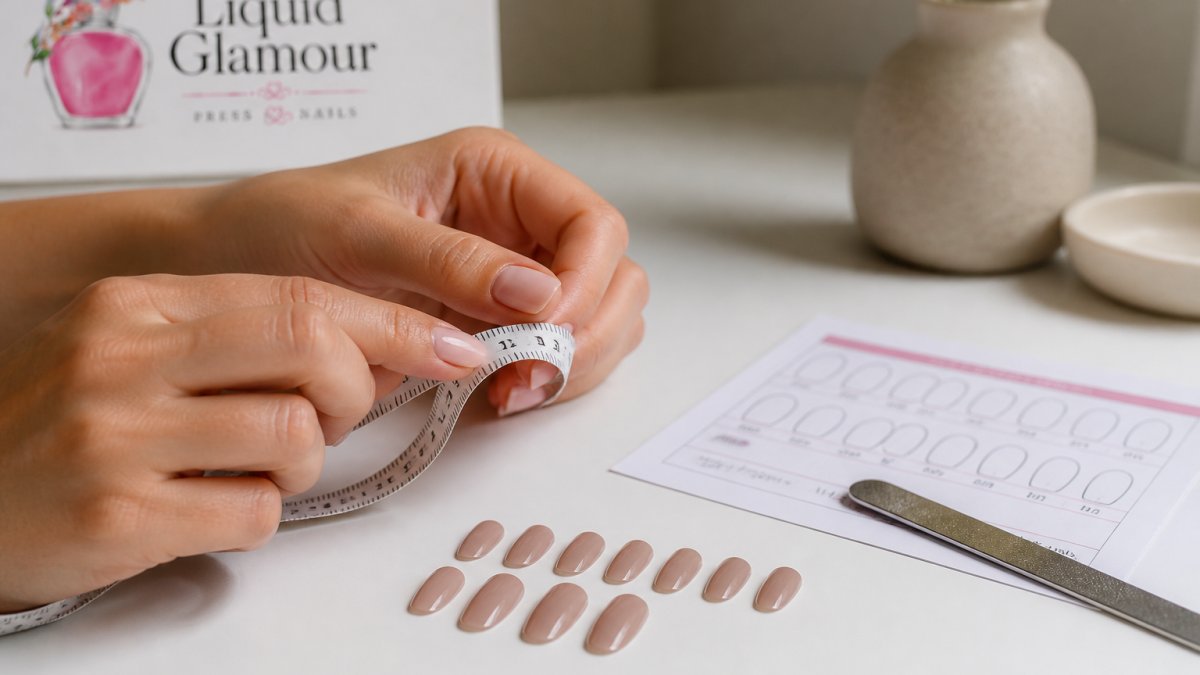
How to Measure Nail Width at Home
Measure each nail individually, because most people have at least one thumb or pinky that differs from the rest. A common mistake is measuring once and applying that number to all ten nails.
- Wipe the nail clean and dry it fully
- Lay a soft measuring tape or a strip of paper across the widest part of the nail bed
- Mark the left and right edges precisely
- Measure the marked distance in millimeters against a ruler
- Write down all ten numbers, thumb to pinky, for both hands
- Repeat on a second day to confirm the numbers hold steady
Measure at the widest point, which usually sits just above the cuticle. If a nail curves sharply at the sides, measure the flat top surface only, since that is what a press-on can actually sit against.
Reading a Size Chart and Choosing a Set
A size chart maps millimeter widths to numbered sizes, typically 0 through 11 or 12, with smaller numbers for narrower nails. Match each finger to the closest size, then check the next size up and down.
Two rules keep this simple. First, round down rather than up when you are between sizes, because a slightly narrow nail can be filed at the sides while an oversized one cannot be shrunk. Second, confirm the set includes enough small sizes for your pinkies and ring fingers.
What to Do When You Fall Between Sizes
Between-size nails are the norm, not the exception. If your measurement sits halfway between two sizes, choose the smaller size and plan to file the sidewalls.
If the smaller size pinches at the sides, you can gently warm the press-on with a hairdryer on low for a few seconds to soften it, then press it onto the nail bed and hold until it cools.
For nails that are narrower than the smallest size, look for petite sets or file down the smallest size.
Petite Press-On Nails: What to Look For
Petite press-on nails are sets built with a narrower size curve, meaning the smallest sizes are genuinely small rather than scaled-down versions of a medium. Look for three things in the listing.
First, check whether the brand publishes actual millimeter widths per size, not just S, M, and L labels. Second, confirm the set includes multiple nails in the smallest two sizes.
Our Essential Solid set comes in Small, Medium, and Large across three shades, which gives smaller hands a genuine starting point instead of a one-size compromise.
Short Press-On Nails That Suit Smaller Hands
Short press-on nails are the single biggest visual upgrade for small hands. Proportion matters more than length: a short nail on a narrow bed reads as balanced, while a long nail makes the whole hand look smaller by contrast.
Short length also solves a practical problem. Shorter nails have less use, so they are less likely to catch on keyboards, seatbelts, and gym equipment, which is where most lifting starts.
Nail Shapes That Flatter Small Hands
Shape changes how wide a nail appears. For narrow beds, the goal is a tapered outline that draws the eye upward.
- Squoval: the safest everyday choice, neat without sharp corners. Our Natural Soft Pink Squoval Solid is a good example of this shape in a short, natural tone.
- Short almond: a tapered shape that slims the appearance of the nail and elongates the finger.
- Square: works well when kept short and narrow, as in our Classic Soft Pink Square Nails, but avoid wide square tips on very small beds.
- Round: the most forgiving option for children and anyone new to press-ons.
If you want visible design without bulk, our French 3D Metallic Wind Pink Short Almond Nails pair a short almond outline with detailed art, so the shape stays slim while the design carries the interest.


Custom-Size Press-On Nails and Made-to-Order Options
Custom-size press-on nails are made to your individual measurements rather than pulled from a fixed size curve. This is the most reliable route for anyone whose widths fall outside standard ranges, including small hands, children, and people with one or two unusually narrow nails.
Classic Soft Pink Square Nails →
How Custom Ordering Works
Expect to supply ten width measurements, and sometimes a photo of each hand with a ruler held across the nail bed for scale. Most makers ask for measurements in millimeters and may request a second set taken on a different day to confirm consistency.
Turnaround varies. A common pattern is one to three weeks from order to delivery, depending on the maker's queue and whether the design is stock or fully custom. Rush options may be available for an extra fee.
When Custom Sizing Is Worth It
Custom sizing pays off when your measurements fall consistently outside a standard set's range, when you have a pronounced curvature that flat press-ons cannot hug, or when you want a specific shape and length combination that stock sets do not offer in your size.
A middle path works well too. Buy a standard set that includes small sizes, then file the few nails that sit slightly wide. This gets you most of the benefit of custom sizing without the wait or the higher cost.
Communicating with a Maker
Be specific. Send your ten measurements in millimeters, note any nails that curve sharply, and mention if you plan to wear the set with adhesive tabs versus glue, tabs add a small amount of thickness and can affect fit. If you have a photo of a previous set that lifted, include it; makers can often diagnose the fit issue from the pattern of lifting.
Fit Troubleshooting: Filing, Adhesive Tabs vs. Glue, and Wear Time
Fit problems usually trace back to one of four causes: width, curvature, prep, or adhesive choice. Work through them in that order before blaming the nails.
| Problem | Likely Cause | Fix | Impact |
|---|---|---|---|
| Nail lifts at the sides | Press-on is too wide | Size down and file edges | Restores full contact |
| Nail pops off whole | Poor prep or oily nail bed | Buff, wipe with alcohol, reapply | Stronger bond |
| Gap at the cuticle | Nail is too long for the bed | Choose shorter length | Natural look |
| Pressure or soreness | Curvature mismatch | Soften the nail with gentle heat | Comfortable fit |
| Lifting after 2 days | Adhesive tab too small | Switch to glue or larger tab | Longer wear |
Filing is safe when done correctly. Use a fine-grit file and work in one direction along the sidewall only, never across the top surface, and check the fit after two or three strokes. Over-filing thins the nail and weakens it.
Adhesive Tabs or Nail Glue?
Adhesive tabs are the better default for small hands and for anyone applying press-ons at home. Tabs are forgiving, allow repositioning, and come off cleanly, which makes them ideal for reusable nails and for short wear of a few days.
Nail glue gives a firmer, longer hold and suits people who need a full week or more, or who are hard on their hands. The trade-off is less room for error and more care needed at removal. Many sets, including ours, include both so you can choose per occasion.
Application, Removal, and Natural-Nail Care
Application takes minutes once your sizing is right. Start with clean, dry, polish-free nails, push back the cuticles gently, and lightly buff the surface to remove shine.
Removal deserves the same care. Soak hands in warm soapy water for several minutes, then ease the nail off from the side with a gentle rocking motion. Never pry upward from the tip.
Natural-nail health matters most for anyone whose nails are already fragile from gel manicures. Peeling and cracked nails benefit from breaks between sets, cuticle oil, and keeping press-on wear to shorter stretches.
If you have damaged or sensitive nails, size carefully and favor adhesive tabs over glue, since tabs release with far less stress on the nail plate. For guidance on nail health and safe cosmetic practices, the American Academy of Dermatology's nail care guidance is a useful reference, and the FDA's cosmetics information covers consumer safety basics for cosmetic products.
Frequently Asked Questions
How do I find press-on nails that fit small hands?
Start by measuring the widest part of each natural nail with a soft tape measure or a piece of paper and a ruler. Compare those widths in millimeters to the brand's size chart. Look for sets labeled petite or small, and check whether the brand offers a mixed-size set. A set that matches your thumb and pinky widths, not just your middle finger, will sit flatter and last longer. If you fall between sizes, size down and file the edges slightly rather than choosing a wider set that overhangs the cuticle.
Can you put press-on nails on short nails?
Yes. Short natural nails are actually a good base for press-ons because there is less free edge to flex and lift the adhesive. Keep your natural nails clean, dry, and lightly buffed, then choose a short-length press-on set so the artificial nail does not extend far past your fingertip. Short press-on nails in squoval or short almond shapes sit closer to the nail bed, which reduces the lever effect that pops longer nails off. Avoid trimming a long press-on down to fit, since the cut edge exposes the inner structure and weakens the tip.
What is the best nail shape for small hands?
Short almond, squoval, and short square shapes tend to work best on small hands. Short almond and tapered shapes create a slimmer appearance and make fingers look longer, while squoval keeps a practical, rounded edge that resists snagging. Very long stiletto or coffin shapes can overwhelm a small hand and put more stress on a narrow nail bed. If you want a classic look, the Classic Soft Pink Square Nails at $9.99 offer a neat square shape, and the Natural Soft Pink Squoval Solid at $6.99 gives a softer squoval alternative for everyday wear.
Can I get custom glue-on nails for small nail beds?
For a faster option, choose a brand with a small size and use the included nail glue for a stronger hold than adhesive tabs.
Small hands should not mean settling for sets that lift, gap, or look outsized. Measure your nail beds once, choose a narrower size curve, and keep lengths short. At Liquid Glamour Nails, our reusable press-on sets are built for exactly this: salon-quality designs with small, medium, and large sizing options, adhesive tabs and glue included, and styles that rewear instead of ending up in a drawer. Get started with Liquid Glamour Nails and find a set that fits your hands properly the first time.